Sobering, isn't it?
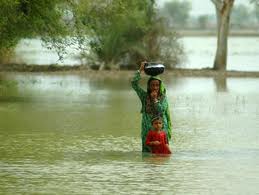
Floods on the Indus river and its tributaries have engulfed one-fifth of the landmass of Pakistan, an area the size of Italy. While the numbers tend to be imprecise, what seems clear is that over 17 million people have been affected. As of 3 October 2010, Pakistani authorities report that 1,600 people are dead, and another 2,366 injured. But, five million people lack shelter, and another 800,000 are stranded in isolated areas. There are 3.5 million children at risk of waterborne diseases, and 70,000 more are at high risk of death according the the United Nations World Health Organization. The Pakistani government estimates that 1.2 million houses, 10,000 schools, 35 bridges, and more than 9 percent of Pakistani highway systems have been damaged or destroyed. Over 20 percent of Pakistan's farmland, primarily in Sindh area has been inundated, and more than 60 percent of Pakistan's export cotton crop has been destroyed.
According to United Nations reports, the floods in Pakistan are a humanitarian disaster that eclipse the 2004 tsunami in South Central Asia, and the Haiti earthquake of January 2010 put together in terms of the people rendered homeless. Although the number of deaths is smaller, the number of people homeless (14 million in the Pakistan floods) compared with 200,000 in the Asian tsunami and three million in the Haiti earthquake reflects the magnitude of this catastrophye. Daniel Holmberg, the head of the Pakistan mission for NGO Action Against Hunger (ACF) doubts that the international reaction will be anywhere near what is needed on the ground.
Reaching the people in the affected areas of the northwest part of the country is almost impossible, particularly in the Swat Valley. The flooding is enormous, the infrastructure largely destroyed, last year's conflict between the Pakistani Army and the Pakistani Taliban insurgents compounds the problems of facing international NGOs. Most people have lost everything, and the situation is much worse than the earthquake in 2005 in Kashmir in which 80,000 were killed and three million made homeless. Although aid organizations have been trying to use any means (taxi, mule, foot) to get aid to these areas, until now, in early October 2010, only military helicopters are able to get through to reach the needy in the most remote areas.

In the context of this massive catastrophe, Pakistan has sought foreign aid for both relief and rehabilitation, as well as reconstruction. While some aid has flowed into Pakistan, as I wrote in my last post, it has not come into the country as fast, consistent, and dependable as needed, or even as provided previously in other similar natural disasters. Reports in the media talk about how, with the collapse of the infrastructure system, it is the Islamist relief organizations that have moved into these areas and have been building a base. While I mentioned in my previous post the role of Islamist relief organizations in providing aid to the affected areas, assumptions about the role of these organizations may not be completely based on the facts or reality.
For example, in a recent report I read about the earthquake in Kashmir in 2005, the writer wrote:
Maybe a look at an earlier natural disaster in Pakistan will help clarify some of the issues. In October 2005, Pakistan was hit by a 7.6 magnitude earthquake, from which an estimated 74,000 people died, 70,000 were seriously injured, and over 2.8 million were left homeless. A lot of foreign aid flew into Pakistan and that time, and over time things became better. Five years later, one often finds media reports which assert that jihadi organizations and their charities were able to build a base by involving themselves in relief work after the earthquake.
However, a recent statistical analysis by Professor Tahir Andrabi of Pamona College and Jishnu Das of the World Bank shows not only how foreign aid helped with the hearts and minds in the earthquake-hit areas of Pakistan, but also that even four years after the incident there was no lessening of good will for foreigners in those areas. Further, the study demonstrates that less that 1% of the population in the devastated areas reported any help from Islamist charities and organizations.
But, is this the situation today?
Charity Navigator, in the U.S. wrote in its blog post of 12 August 2010, "Why Aren't We Giving More to Relief Efforts in Pakistan?" that some of the reasons are:
- Recession - Overall, giving in America was down 3.6% from 2008 to 2009.
- Recent Disasters - Donors already responded generously this year to the Haiti earthquake (more than 1 billion given in the first four months) and to a lesser extent to the earthquake in Chile and the Gulf oil spill. So this might suggest donor fatigue.
- Haiti - The media has reported that much of the promised aid money had not reached Haiti and that relief efforts have been very slow. This leaves a bad taste in the mouths of those who have contributed and causes them to think twice about supporting relief efforts in another part of the world.
- Summer - Sadly, the timing of this tragedy may be having an impact on donors. With summer vacations, they may not be playing as close attention to the news as they do at other times of the year.
- Media Coverage - In contrast to the coverage of the earthquake in Haiti, the media coverage of the Pakistan floods has been minimal. As they say, our of sight, out of mind.
- Victims - The scale of the Pakistan disaster has eclipsed the disastrous tsunami in South Asia in 2004 (which generated donations of more than $1.5 billion). Yet, tens of thousands died in the tsunami, not to mention hundreds of thousands who lost their lives in Haiti this past January.
- Corruption/Terrorism Link - Potential donors may be weary of the government and others in Pakistan. They worry if their contribution will really be used to provide aid, as they intended, or diverted to causes they do not wish to fund. In fact, there are already reports that various Pakistan charities which are fronts for terrorist groups are getting involved.
- Government - Even with concerns over corruption and ineptitude, some may view the government in Pakistan as being more able to care for its citizens than, for example, the government in Haiti. For example, the government's capacity to help had a dampening effect on giving to Chile after the February earthquake.
David Ignatius, writing for The Washington Post on 29 September 2010 from Pir Sabak, Pakistan, reported the Pakistani government was not prepared for this kind of disaster and was taken back by its magnitude. "The flood has deepened a national mood that often seems close to despair." He said:
The U.S. military has been working hard to provide food assistance, but most of that is invisible to Pakistanis. They read about American drone attacks but not about helicopters bringing food supplies. That lack of recognition upsets U.S. officials, but they haven't been able to change it.
On a day's tour of the northern flood zone, I saw posters for Turkish, British and other European relief groups, but not one sign of American help. That's a missed opportunity. These people still need help, desperately, and they will remember those who visibly provided it.But just a week later, writing in The Washington Post on 5 October 2010, Mr. Ignatius reported from Islamabad that,
Hundreds of Americans have been working their butts off to help Pakistan cope with their flood disaster, and they haven't been getting much credit for it -- including from me.
* * *
I wrote last week from a village called Pir Sabak in northwestern Pakistan that U.S. flood relief wasn't evident there, or elsewhere along the way. "The U.S. military has been working hard to provide food assistance, but most of that is invisible to Pakistanis," I noted. That seemed to me to be a missed opportunity -- and characteristic of a weird misfire in U.S. public diplomacy. For a superpower, we can be oddly shy about advertising our good works.
I have since talked more about this problem with U.S. official managing the relief effort, who felt their colleagues' work had been slighted. They're right; America has been making a big effort to help the flood victims, more than any other nation. But I'm more convinced than ever that the way we're doing it -- providing food aid through the United Nations, for example, and focusing on transporting it rather than taking credit for distribution -- reduces its public impact.
Mr. Ignatius then told about an American official who told him that he had switched from focusing on security issues to supervising flood relief; that America's first priority is helping people rather than bragging in the Pakistani media about it. His reaction to this statement by the American official was:
Maybe that makes our assistance true humanitarian aid, offered to help people rather than to gain political benefit. But unselfishness has its limits. American do-gooders can make anonymous private contributions if they want. Our public assistance should get some return. In a country as anti-American as Pakistan, it doesn't make sense to be quite so low-key.
American soldiers and civilians here have been making a difference in helping the desperate flood victims, and their work shouldn't go unsung, by Pakistanis or by visiting columnists.
What is missing from any of this analysis by Mr. Ignatius is any sense that there is a humanitarian disaster of catastrophic proportions that requires some kind of moral obligation that we as humans have to relieve the suffering of the victims of this flooding. The gist of these three columns, all written within the space of about 10 days, is that there should be some kind of political benefit in the war that could come from the U.S. government providing more open acknowledgment of its humanitarian efforts, rather than simply providing humanitarian and relief assistance to the victims of the flooding. The emphasis is on what the U.S. government should be doing in publicizing its humanitarian efforts, to offset the bad publicity from its drone attacks; not what it is actually doing.
What I find troubling about these pieces is what appears to be his dismissive attitude toward humanitarian and relief assistance provided by NGOs. His statement, "But unselfishness has its limits. American do-gooders can make anonymous private contributions if they want." does not inspire NGOs to engage in any relief or reconstruction effort in Pakistan. This comment surely is not designed to inspire generosity on the parts of donors all over the world seeking to participate in some way to addressing the disaster in Pakistan. Nor does it seem to inspire confidence in Pakistan in the world-wide NGO sector. Cynicism simply becomes the goal of this kind of national self-aggrandizement.
The Washington Post on Sunday, 3 October 2010 had a dispatch from Warsak, Pakistan, reported the following:
In the same week when U.S. helicopters mistakenly killed three members of Pakistan's Frontier Corps near the Afghan border, American Special Forces were training members of the same force on how to use radios, sniper rifles and other counterinsurgency tools at a remote base here.
Pakistanis and Americans don't talk much about this joint training camp, northwest of Peshawar about 20 miles from Afghanistan. But the program is a symbol of the weird duality of the relationship - - a mix of public distance and private cooperation that's awkward for both sides.In the same edition of this paper, the front page article was titled, Military drones aid CIA's mission. The gist of this article was that the strategy in Pakistan carries significant risks, where the CIA is using an arsenal of armed drones and other equipment provided by the U.S. Military to secretly escalate its operations in Pakistan by striking targets beyond the reach of the American forces in Afghanistan. This article continued:
The strategy shift carries significant risks, particularly if it is perceived as an end-run around the Pakistan government's long-standing objections to American military operations within its domain.
Indeed, the surge in drone strikes over the past four weeks has to a large extent targeted elements of a network led by Jalaluddin Haqquani, a militant regarded as a close ally of Pakistan's powerful Inter-Services Intelligence directorate.
There has been much in the newspapers in American in recent weeks about these drone strikes and a new book, Obama's Wars, by author Bob Woodward has just added to the discussion. And of all times, when there is this humanitarian crisis presented almost daily in our various news sources. One such example, is the following report:

Hours later, gunman attacked and burned two supply trucks carrying NATO supplies in Southwest Pakistan killing the driver.


As I write this post, Osama bin Laden presumably just issued a second tape in that many days, saying that governments of Muslim nations have not done enough to help Pakistanis affected by floods that killed hundred, and maybe thousands, and displaced millions. In his earlier tape just 24 hours earlier, he urged his followers to overthrow the leaders of nations like his native country, Saudi Arabia, and Egypt. In his earlier message, he called "for the establishment of a relief organization to prevent flooding in Muslim countries, create development projects in impoverished regions, and improve agriculture to guarantee food security." There is no question that much of Pakistan's agricultural capacity has been lost in these floods. Food crops have been destroyed and the seed for future years also lost.
Here, he spoke to the humanitarian needs, like the floods in Pakistan, and climate change. Although the vitriolic attacks against the West were absent, his focused criticism was on Arab leaders accusing them of failing to respond to this disaster in a Muslim country. He said: "The [U.N.'s] secretary-general came to witness the catastrophe for himself, and yet no Arab leaders came to witness the disaster despite the short distances and claims of brotherhood."
What is becoming clear to many, American strategic goals in Afghanistan are tied to what happens in Pakistan. Reported in Bob Woodward's book, Obama's Wars, is a statement attributed to President Obama during a White House meeting with his national security team. In an excerpt from this book printed in the Washington Post newspaper, we read,
Fears about Pakistan had been driving President Obama's national security team for more than a year. Obama had said toward the start of the fall 2009 Afghanistan-Pakistan strategy review that the more pressing U.S. interests were really in Pakistan, a nuclear power with a fragile civilian government, a dominant military and an intelligence service that sponsored terrorist groups.
Not only did al-Queda and the Afghan Taliban operate from safe havens within Pakistan, but -- as U.S. intelligence officials had repeatedly warned Obama -- terrorist groups were recruiting Westerners whose passports would allow them to move freely in Europe and North America.
Safe havens would no longer be tolerated, Obama had decided. "We need to make clear to people that the cancer in in Pakistan," he declared during an Oval Office Meeting on Nov. 25,2009, near the end of the strategy review. The reason to create a secure, self-governing Afghanistan, he said, was "so the cancer does not spread there."According to the Washington Post series of articles that excerpt the book, looking at the National Security Strategy laid out by the President in May 2010, we do not find that Pakistan is a top concern.
Amidst steadfast commitment to liberalist principles calling to defeat terrorism with multilateralism, in adherence to international law and a sensitive awareness to growing interdependence in an increasingly globalized system, the document reads our security objective as such:
"to disrupt, dismantle and defeat Al Qa'ida and its affiliates through a comprehensive strategy that denies them safe haven, strengthens front-line partners, secures our homeland, pursues justice through durable legal approaches, and counters a bankrupt agenda of extremist and murder with an agenda of hope and opportunity. The frontline of this fight is Afghanistan and Pakistan."
Naming Pakistan alongside Afghanistan underscores the President's shifting focus. The policy refers to Pakistan as the "epicenter of violent extremism" and warns "danger from this region will only grow if it's security slides backward."As I wrote above with regard to David Ignatius' columns in The Washington Post, the White House issued a report to Congress on Afghanistan and Pakistan during the first week of October 2010 presenting the security situation as very bleak. As is the case in many of these kinds of reports, it was leaked to The Wall Street Journal. What drew attention to this report was the discussion of the deteriorating situation in Pakistan and the Pakistani military refusal to mount a new offensive against the Taliban and Al-Qaeda in North Waziristan. The White House did concede that after the devastating floods in August, the Pakistani military was swamped with relief work and that the political choice was a reflection of the under-resourced military. According to Mr. Ignatius, writing for The Washington Post, "the sharp critique will add more fuel to the combustible U.S.-Pakistani relationship."
The Wall Street Journal reported in its article of 6 October 2010 concerning the White House report to Congress, that "questions about aid to Pakistan have been growing in Congress in recent months, and congressional aids said the downbeat assessment could fuel lawmakers's qualms and calls for putting more conditions on U.S. funding."
 In mid-August, UN Secretary General Ban Ki-moon visited flood-devastated Pakistan, which he described as "heart-wrenching." He announced another $10 million from the UN's central emergency response fund, making a total of $27 million from that fund. Additionally, the UN launched an appeal for $459 million for emergency aid for Pakistan, noting that billions would be need for the long term. However, as reported several days later, "the response to the crisis has been less than enthusiastic," with only about half of the $459.7 million requested by the UN having materialized.


According to the Center on Philanthropy at Indiana University, during the first five weeks of the crisis, individual and corporate giving to relief organizations helping Pakistan was estimated at just over $25 million. This in contrast to the $900 million given in aid funds during the first five weeks after the earthquake in Haiti in January 2010, and approximately $2 billion given to the victims of Hurricane Katrina at the five week mark. There was a widely held perception that the money would go to armed terrorist groups and that no donation was secure.
The Chronicle of Philanthropy reported in late August 2010 that the donations to help flood victims of the Pakistan floods had picked up a little as the news-media attention of the disaster increased. Whereas, in two and a half weeks after the Haiti earthquake, 40 aid groups had raised a total of $560 million, only 22 aid groups had raised $10.6 million for the victims of Pakistan.
Charity Navigator reported that as of mid-August 2010, a dozen of the largest charities in the United States had only raised $5 million. Charity Navigator listed 37 American charities that were providing relief and that were highly respected with a history of working on massive disasters and/or working in Pakistan. These included Action Against Hunger, Action Aid International, American Jewish World Service, AmeriCares, The Asia Foundation, CARE, Doctors Without Borders, Episcopal Relief and Development, Food for the Hungary, Islamic Relief USA, MAP International, Medical Teams International, Samaritan's Purse, Save the Children, United Methodist Committee on Relief, United States Fund for UNICEF, World Vision, American Red Cross, Care, Oxfam America, Plan USA. Most of these were accredited by BBB Wise Giving Alliance and ECFA, both ICFO member monitoring organizations, and received four star ratings from Charity Navigator.
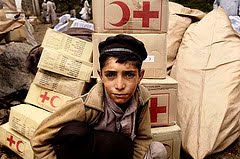
Many international relief organizations are not actively soliciting funds for relief efforts in Pakistan because they don't have programs in the country. This of course makes sense because one of the tips which we give to potential donors is that they give to an established charity that has worked in the country of the disaster, in this case in Pakistan. In other words, find a charity that has a proven record of providing disaster relief, and preferably, one that has worked in Pakistan. Many of the charities listed in the preceding paragraph have been working in Pakistan for many years, and particularly since the Kashmir earthquake of 2005.

One of the reasons people aren't giving to humanitarian relief is that Pakistan, and particularly the flooded areas, has a global reputation for being dangerous. Pakistan lacks the kind of network for Western charities that was present in the case of Haiti's network. This is related, part to the fact that Pakistan is a Muslim country. As a result, it lacks a pre-existing network of Christian humanitarian organizations and missionaries.
In the case of Haiti, the Christian missionaries, predominantly Americans, were doing a combination of humanitarian work and religious outreach. This was important because these organizations and missionaries were able to use the American churches as a vast grassroots network to communicate the situation in Haiti to Americans. This also allowed them to tap into existing funders and the donating public that had already established a relationship with the work in Haiti. Pakistan has no similar large and long-term presences. This has made it more difficult to tap into the fundraising resources in America.
 I read one observation that since the World Economic Forum ranked Pakistan as 113 out of the 133 countries to which tourist travel in its latest Travel and Tourism Competitiveness Report, Pakistan simply cannot draw the attention for fundraising to address the humanitarian crisis presented by the flooding. It is sad that we might think that popularity with holiday-makers is a fair way to allocated disaster relief, and yet this seems to be one of the factors that has resulted in the absence of generosity in the case of Pakistan as compared with that generosity displayed in the disasters in Haiti, Chile, or South Asia.
 The advice on giving is always good when faced with disasters, such as that occurring in Pakistan due to the flooding. Give only to established organizations that are already on the ground. These know the people, know the conditions, and have the experience to work locally, networking with existing relief resources. Second, it has been suggested that giving should be primarily in the form of cash, rather than goods and gifts in kind. Pakistan is a long way away, and the time for shipping goods and the expense involved in that shipment, the value of the gift is reduced. Moreover, with cash, organizations on the ground and within the region can purchase the needed supplies closer to the place of greatest need. Third, there is a tendency to earmark contributions. While there is value in this, it is better to give to organizations with which the donor is familiar and can trust to do what is best in the situation.
 Paradoxically, as the U.S. Secretary of State was announcing additional $60 billion US funding beyond the $150 million already announced earlier, the Pakistani government denied permission to use the US controlled Shahbaz Air Force Base in southern Sindh province for flood relief operations. "Foreign health teams could not start relief operations in remote areas because there are no airstrips close to the several areas, including Jacobabad," according to Dr. Jahanzeb Aurakzai, the coordinator of the Health Emergency Preparedness Centre.
National and international NGOs reported that they could not reach Jacobabed to provide food and drinking water to as many as 500,000 to 700,000 flood victims due to the strict security conditions adopted for Shahbaz Air Force Base.

Only a small fraction of the six million Pakistanis that were desperate for food and clean water received any help. The UN complained that foreign donors had not been quick or generous enough in light of the scale of the disaster. There was mistrust both outside Pakistan and inside that aid would get to the people that needed it.
 U.S. Secretary of State Hillary Clinton in an interview with a newspaper defended Washington's corrupt-client government of Pakistan by describing corruption as a "diversionary side issue." She said:
The United Nations Department of Safety and Security continues to advise all humanitarian staff to be aware of the security risks in the affected areas, including those directly related to the flooding, such as violent demonstrations and aid-related crimes."Corruption, unfortunately, has been with us, is with us, and always will be with us. It must be attacked and it must be rooted out but I don't think, it does a service to the people who are suffering to have some diversionary side conversation about corruption."


With the increased attention in both the print and electronic media to military offensive in Pakistan, the drone attacks, the activity of Taliban and Al-Qaeda groups operating in Pakistan, Pakistan's recent closing of the border crossings with Afghanistan, and the militant's attacks against the fuel trucks, news concerning the floods and the work of NGOs in Pakistan has generally disappeared from print and television.
Moreover, as in the case of many natural disasters, there is frequently the question as to whether the devastation is cause naturally, or whether there is a human component that either increased the potential disaster, or exacerbated the damage or destruction. I discussed this issue in my post of 21 February 2010, Haiti Earthquake 2010 and Challenges to Recovery. In the case of the Pakistan floods, this issue has been raised again.
First, there have been reports that the flooding was largely initially confined to the poorer areas of the country, and specifically affected only those who were poor and powerless. The initial flooding was minimal and caused minimal damage and destruction to those where were part of the elite and wealthy class.
Secondly, the distribution of relief has alleged to have been uneven. According to these reports, government agencies and Muslim organizations in Pakistan have been denying aid to thousands of Christians left homeless by the floods. As one report stated:
But the Pakistan Christian Congress says that the afflicted Punjab region is a "hotbed" of Islamic extremist organizations that view Christians as infidels, and local officials who fear the extremist have been barring Christians from tent camps set up for flood victims.
* * *
The Anglican Bishop in Peshawar, Pakistan said that although some countries would come forward with aid packages, hardly any of it would reach the minority Christians. Christians comprise approximately 2 percent of Pakistan's 175 million people and have been subject to attack from extremist groups who accuse them of blasphemy.Open Doors USA President Carl Moeller, whose organization has been working in Pakistan, said: "The only place with aid for many is their local mosque, which places Christians in an extremely vulnerable situation. Some are flatly denied assistance while others are told to vacate the region or convert to Islam. Imagine giving up your faith in order to feed your starving children."
Thirdly, The Times of India, recently reported that Pakistan's Prime Minister said that 80 percent of the international assistance would be spent by international organizations. However, he also noted that about half of that amount would be returned to the coffers of the international NGOs. According to the Prime Minister, "the foreign aid workers would hire offices in expensive areas, draw salaries in dollars and require bullet proof-vehicles for use. Hence, a big chunk of the aid aimed to be spent on affected people will be wasted this way."
 Fourthly, because of the presence of the Taliban of Pakistan, Al-Qaeda, and other militant organizations, many of the areas in which these relief worker are providing aid to the victims of the flooding are dangerous. For example, in March 2010, before the major flooding, militants attacked the offices of World Vision, a Christian humanitarian charity that has been providing aid in Pakistan since the earthquake of 2005 helping women and children. Pakistan government officials reported that a group of 12 to 13 militants stormed the offices of World Vision in Oghi, a remote village of Mansehra, putting all the employees in one room and then started shooting. Six aid workers, two of them women, were killed and eight others wounded. All of these were Pakistanis. The militants then threw grenades which destroyed the building. Some people in Oghi reported that they had observed the police watching as the attackers fled into the nearby mountains.
Even as Christian aid groups, like World Vision and Operation Mobilization continue to deliver aid to the flood victims in Pakistan, the Taliban and other militant groups have warned that foreign aid workers will be targets for attacks. A U.S. official said that violent threats to foreign aid workers came from Tehrik-e-Taliban, the countries most extremist group.
 As I have read over my posts about the earthquake in Haiti, and now about the flood in Pakistan, I cannot help but wonder if this is what we mean when we speak of donor fatigue. I wonder if we aren't all getting a little tired about hearing and reading about these natural disasters, and about receiving all the solicitations for money. But as I have tried to describe, it is so much more. Because, in the case of the Pakistan floods, the news media, both print and television, have largely ignored the story of the floods, focusing instead on the drone attacks, the closing of the borders with Afghanistan, and the attack against the tanker truck stranded by the closing of the border crossings.
I also wonder if when we combine these appeals with all of the charges of corruption, of wars, of fears about terror, we become bored by the repetition of the news were hear and ready to move on to other things.
Could it be that most of us can watch scenes and events like this on television, but could not watch them in real life? Put them on the screen and we can watch them. Some people may start to analyze them, and marvel at the power of the river and the horribleness of war, but that is it. However, if one were to see them in real life, one would be expected to intervene, to rescue the victims or to come to the aid of the victims. To do something.
I think one of the things that has happened with our ability to see things on the screen may be illustrated by what happened in Haiti, or the starving in Darfur, or the death and destruction and hopelessness of Pakistan, is that we see them and absorb them, realizing something horrible has taken and is taking place on our television screens, knowing that there is no question about what we are seeing, and then we simply just pass on. And we say that, yes, people starve in places like Darfur, and lose their lives and homes and livelihoods in places like Haiti or Pakistan, but what can one do about that? We don't necessarily become harder or colder to what we are seeing. Rather, we simply accept it. We become detached, and therein lies profound social problem.
Watching and participating is the basis for a real moral dilemma. If we are just an audience, it is easier for people to do terrible things, or for us simply not to take any more than a fleeting interest in what we see. I am not sure that even responding to an appeal for funds on television by calling a number or texting a donation to a large and somewhat anonymous NGO can be considered moral participation in the relief of the disaster. But then, why respond when all of the emphasis is on what the UN should do through its agencies, what the international community, particularly, national governments, should do, and what the Pakistani government should do for its own people.
Doesn't this just say what we think but are afraid to say out loud? Does this seem to explain why so little aid has been provided to the people of Pakistan as I wrote in my last post, and as repeated in the media?