Saturday, September 18, 2010

The Pakistan Flood of 2010 and Relief Aid


There are so many natural disasters calling out for attention and help that it is sometimes difficult to decide which one should be addressed in the media on a sustained basis.  Too often, the disaster occurs someplace far away where, for many reasons, there is little public attention.  For example, the recent volcano eruption in Indonesia, or maybe the volcano eruption in Guatemala in May 2010, followed by severe flooding caused by a hurricane.  Then, as I write this, there are devastating mudslides along the Pan-American highway in Guatemala close to the villages of Tecpan and Nahuala killing at least 44 people, leaving 40,000 people homeless and another 10,000 evacuated.


The earthquake in Haiti in January 2010 and the needed relief and development has stayed in the news for much of 2010, although it has been moved from the front pages of the newspapers and off the television news reports.  Yet, as I wrote earlier, the need will persist, and there will be reports about whether the United Nations funds, the government grants of aid, and the work of the NGOs in the area have been effective, and whether there has been any level of transparency and accountability in connection with those efforts.


The flooding in Pakistan which started in June 2010 has produced a slightly different story and perspective, particularly with regard to outside aid.  The map displayed in this post depicts the level of flooding and the affected area due to that flooding.  Because of the level of devastation and the effects of the continued flooding, the statistics regarding the deaths, injured and diseased, homeless, and destruction of property will remain fluid.  As a result, the statistics, tentative as they are, will be outdated by the time this post is read.  What remains important, however, are the questions and lessons one might take from this disaster.


It is hard to imagine the level of devastation covering a third of the country.  In other words, an area the size of Britain covered by the flooding.  According to the most recent reports I have seen, the death toll has risen to 1,738.  According to Pakistan Disaster Authority Officials, at least 17 million people have been affected, with 600,000 to 800,00 displaced from their homes in Dadu in Pakistan's Sindh province by new flooding in just the last four days.  The areas of Mehr Tehsil, Kher pur Nathanshah and Jodi are under water.  As stated by the UN special envoy for Assistance to Pakistan, Jean-Maurice Ripert, "We still have millions of people out of their houses." and "we have hundreds of thousands of people that we have to feed, take care of on a daily basis."


And as CNN reported on Saturday, 4 September 2010, "But the nightmare isn't over for the survivors.  Water-borne illnesses from contaminated flood waters have erupted nationwide."  At least 1 million Pakistanis have crippling diarrhea or respiratory infections.  About 65,000 cases of malaria have been reported.  The Office of the U.N. High Commissioner for Refugees' representative to Pakistan said that "There is a humanitarian tragedy with immediate threats of water-borne diseases and food shortages."  He further stated that: "I have worked in humanitarian situations globally, and worked in refugee camps in Africa during emergencies, but to be honest I had never seen a situation as devastating as I saw in Balochistan."  The United Nations warned that a crisis was building in the eastern province of Balochistan, where nearly 2 million people are affected.


The U.N. Financial Tracking Service has published the funding status of the latest appeals for humanitarian relief for Pakistan.  The statistics show the donor, the channel for funding, the description of donation, funding pledges and the uncommitted pledges. The table of commitments, contributions, and pledges is current as of 4 September 2010.  According to this table, a total of US $797,194,251 had been contributed to Pakistan flood relief, and a total of US $317,671,622 pledged but not committed.  These numbers represent contributions made by governments bilaterally to Pakistan as well as contributions made through NGOs.


While these figures might seem impressive for the uninitiated, when compared with the giving for the relief in Haiti following the earthquake in January 2010, the giving is not that impressive.  As stated by Jean-Maurice Ripert recently, the amount given by the international community to relief in Pakistan is "far from enough."


For example, at this point in addressing the emergency relief in Haiti resulting from the earthquake of 12 January 2010, $2.5 billion had been given, and $1.3 billion pledged.  Countries had provided large components of disaster relief teams, medical staff, and technicians for reconstruction.  Countries provided field hospitals, hospital ships, aircraft carriers, and transportation services.  The World Bank had canceled $36 million Haiti debt and had made $479 million in grants to support recovery and development.


In the Blog of News and Insight, The Rundown, the writer, George Griffin, wrote on 6 September 2010:

American individuals and corporations have given generously to the people of Pakistan suffering from the worst flooding catastrophe in the nation's history.  But that generosity still falls short of the sums Americans have donated to aid victims of other major crises.

The Center on Philanthropy at Indiana University reported that in the first five weeks of the Pakistan flood crisis, individual and corporate giving to relief organizations operating in Pakistan was estimated at just over $25 million, whereas at this point, the giving to relief after the earthquake in Haiti was $900 million, and in the case of giving to relief for the victims of Hurricane Katrina in the U.S. Gulf coast was approximately $2 billion.


This has been the subject of considerable analysis and discussion within the sector and those that watch the sector.

But, first, a little context.

The Center on Philanthropy at Indiana University reported in late 2008 that nonprofit professionals reported the lowest overall level of confidence in the United States for fundraising, with the Philanthropic Giving Index (PGI) reporting a 21 percent decrease in the preceding six months.  Patrick Rooney, the interim executive director put it this way:

This is a hard year for fundraisers at many organizations across the nonprofit spectrum.  These results reflect that the U.S. economy is in a recession.  Our research for Giving USA Foundation shows that the total giving generally declines by about 2.7 percent annually during longer recessions.  While we do not yet know what will happen to total giving in 2008, the PGI is a strong indicator of the difficult challenges fundraisers are clearly concerned with as 2008 comes to a close.
Although this addresses the challenges in the United States, my guess is that since the recession and economic situation has been worldwide, the situation exists around the world.  Since the recession has continued through 2009 and into 2010, it would seem that these challenges have only gotten worse.  But, can that be the only explanation since the fundraising for emergency relief to the people of Haiti was significant by any standard, and certainly in comparison to the funding for the relief in Pakistan?  This report suggested that different types and sizes of organizations are affected in different ways by the economy with human services organizations, such as public benefit, environmental, animal rights, and international organizations reporting a tough fundraising climate, while those organizations working in health doing a little better.


According to the United Nations Financial Tracking Service table listing of all commitments/ contributions and pledges as of 4 September 2010, $797,194,251 have been contributed in actual payment of funds or transfer of gifts-in-kind from the donor to the recipient entity, which may be either the Pakistani government or an NGO.  The table also listed the pledges totaling $317,571,622 uncommitted pledges.


What is interesting from an international perspective is that, according to the Financial Tracking Service of the United Nations, giving to relief and emergency assistance in Pakistan from its Middle East and Central Asia neighbors was minimal.  And, the giving that there was, essentially reflected giving from government to government, government through its Red Cross or Red Crescent, to the Pakistani Red Cross, or government through UN agencies.  Moreover, most of the contributions were in the form of gifts-in-kind.


The worst areas have been totally dependent on outside help.  BBC News reported that in remote areas, roads have been cut off, and donkeys make eight-hour trips to reach people.  With the fresh water warnings and more rain predicted, thousands were struggling with shortage of food, clean water, shelter, medicine.  The International Red Cross was working with local partners to provide packages of aid, such as tents, blankets, stoves, cooking utensils, and the like to families in remote areas.


In one area, 80 percent of the homes were destroyed or badly damaged.  All the mud-brick houses were washed away.  People rely on open wells, which have become contaminated, so access to clean water was a problem.  Many people worked as day laborers, so they have lost both their homes and livelihoods, and must start over.  An area south of Punjab had essentially been turned into a large lake.  This was a desperately poor area where there had been significant agriculture.  Now with the crops destroyed or damaged, food for the villages in the area would be a major problem for the long term.  There were lots of snakes, so there was a major risk of snake bites, as well as water borne diseases, such as dysentery and cholera.


As monsoon rains continued unabated, the situation continued to rapidly deteriorate.  Millions of victims were left to fight for survival with little clean water, food, or shelter.  The demands for urgently needed aid put added pressure on the government and NGOs simply to save lives.  Food, water purification tablets, shelter, medicine, hygiene kits, and medical teams were transported by raft, boat, and donkey.


As pointed out in a 16 August 2010 article in SPIEGEL ONLINE,

When water and food are lacking or disease starts to spread, it is always the children who first feel the affects.  On Sunday, local news outlets reported that five children had died of starvation in the northwestern region of Pakistan.  Aid organizations fear that many more children could perish as a result of the flood catastrophe because of lack of clean drinking water, medicine, and vitamins.

Commenting on the paucity of giving to Pakistan flood relief estimates, SPIEGEL ONLINE article quotes Helga Kuhn, the UNICEF spokeswoman as saying, "the more people learn about the scope of the catastrophe in Pakistan and how many children have been affected, the more they will be willing to help."


In some circles and countries, there is a general sense that it is unethical to use children and pictures of children in dire straits as objects in fundraising appeals.  There may be several reasons for this, including the idea that in relief and development work, children are being used to psychologically manipulate people into to giving for purposes that are broader in a community than simply to address the needs of a particular child pictured in the solicitation for funds.


Yet, where children are the early and principal victims of natural disasters, such as the one in Pakistan, how is the world to understand the devastation that is occurring in that country, and its effect on the young in press reports or appeals for donations?  Is there any difference in this thinking if the appeal is made for emergency and urgent relief in the case of a natural disaster as opposed to simply raising funds for some development projects in a community?  In other words, is there a difference in the ethical considerations for fundraising if the relief and development organization is engaged in child sponsorship in its fundraising program, or is actually raising funds for emergency and urgent relief in a situation like the Haiti earthquake or the Pakistan flood?  Is the use of children in photographs in these cases part of the educational goals of the NGO unethical even if part of the reason for their use is to motivate giving?


Assuming there is an element of manipulation in attempts to motivate donors to give to NGOs providing emergency relief to the victims of the Pakistan floods, is there not always some efforts on the part of NGOs to incentivize giving to such causes, or indeed, to any cause?  Were not the telethons provided by television and movie celebrities to raise money for the Haiti earthquake relief also designed to promote giving on the part of the public?  Is there a fundamental difference from this perspective if the photos are of general devastation and hardship, but do not focus on children who are simply being used as props for the appeal?  While the practice of fundraising in the case of the Haiti earthquake with photographs and video clips of the damage, devastation, death, and hardship does not justify similar attempts to motivate generosity in the case of Pakistan, the question nevertheless continues to press us as to the fundamental basis for moral reasoning regarding the use of photographs, including those that focus on children in distress to play on the sympathies and emotions of the public so that people will give.


International relief efforts through NGOs have included the provision of undefined humanitarian assistance, emergency water and food assistance to families affected by the flooding, tarps, tents and other shelter supplies, buckets, generators,  hygiene and medical supplies and medical equipment, and water sanitation equipment.  Services included mobile medical clinics and medical services, logistical support, aviation support services, safety and security forces, protection activities, and construction services, for example.


Burkhard Wilke, the Director and CEO of Deutsches Zentralinstitut fur soziale Fragen DZI), and former Secretary General of ICFO sent a notice to all ICFO members with a DZI press release concerning donation campaigns in Germany for the victims of the flood catastrophe in Pakistan.  He compared the donation volume to that in the case of the relief for the Haiti earthquake of January 2010, and noted that the volume was significantly less than in the case of the donations for the Haiti relief.


Public television broadcasting stations ARD and ZDF, which had been known for hosting fundraising telethons for natural disasters in the past, have announced that they have no plans to host similar telethon fundraising drives at this time.  German charity organizations, Welthungerhilfe and UNICEF reported that people are hesitant to make donations.  German Agro Action (Welthungerhilfe) stated that "the people (in Pakistan) have the feeling that they have been abandoned."


The following links provide an example of the information provided by ICFO member, DZI.

http://www.dzi.de/pressemitteilungen/DZI-PM_Pakistan_18August2010.pdf

See also:

http://www.dzi.de/downloads/DZI-Spenden-Info-Pakistan-Flut-5.pdf


This press release announced a preliminary figure on donations to the victims in Pakistan as surveyed by DZI.  The press release generally indicated the primary agencies in Germany that had been granted seals of approval for complying with DZI standards, that had provided relief assistance.  However, the importance in this announcement was primarily due to the fact that it signaled a declining flow of contributions and reduced media coverage.


ICFO members responded to Burkhard's message noting that the same general trends obtained in the ICFO respective countries.  While some of the explanations for this diminished response reflected the comments and analysis contained above, there was general agreement that the volume of donations and the attention in the public media was significantly less than had been the case in the fundraising campaigns in the the case of the Haiti earthquake.


Canada's John Pellowe of CCCC reported that questions about the reluctance of people to donate to relief efforts in Pakistan had been a major topic on talk radio programs where the consensus seemed to be that most people regarded Pakistan as no friend of Western nations because it is giving the Taliban what it needs to function, and therefore, indirectly contributing to the deaths of Canadian troops in Afghanistan.  Additionally, there was not a lot of sympathy at this time, and the question as to why wealthy Middle Eastern nations closely aligned with Pakistan were not providing support.


Adri Kemps of CBF in the Netherlands, also reported a drop in donations as compared with Haiti fundraising at this point of time in the Haiti crisis, and noted that the critical questions raised in the media related to the Taliban issue and the perceived ineffectiveness of the support.  Notwithstanding these questions and the apparent reluctance on the part of the donor public, the media outlets present the Pakistan flood as a major human disaster.  The largest Dutch aid organizations argue that human victims need the support now, and that the Dutch should give generously as these largest organizations have opened the well-known disaster assistance back account to jointly collect money for the flood relief.


Edith Archambault of Comite de la Charte in France reported like the others that the giving at this point in France was lower than at the comparable period in the case of the fundraising efforts for Haiti earthquake relief.  As she pointed out, Pakistan is politically ambiguous in comparison to Haiti, which is French speaking with many immigrants in France.  Moreover, August is a slow month in France, including in relief nonprofit organizations.


Switzerland had a national collection day for Pakistan in mid-August, organized by "Gluekskette" in which collections were pooled and distributed to Swiss charities operating in Pakistan.  As reported by the others, Martina Ziegerer reported that giving was down compared to the giving for the Haiti relief efforts.  Media attention was slow in the beginning, but as the media focused on the catastrophe and the human suffering, donation levels started to increase.  Although there was discussion about corruption, charities pointed out that their relief work was directly focused on those needing the aid, and not through the Pakistani authorities.


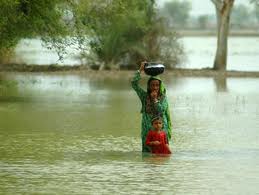
Again, with pictures such as these herein, and many more published around the world, the question is why.  In an article in SPIEGEL ONLINE, the authors pointed out that in Germany, the volume of private donations for flood victims in Pakistan "has been far lower than for other natural disasters in the recent past."

As a hotbed of Islamist extremist activity, the country has an image problem.  But politicians say the suffering people of Pakistan should not be blamed for the activities of the Taliban."

In an interview with SPIEGEL ONLINE, Chancellor Angela Merkel's Ruprecht Polenz, a senior politician with the Christian Democratic Union (CDU), said that there had been two types of reactions to fundraising for the Pakistan flood disaster:  Some feared that their money would be used to help extremists.  Others, said that if Pakistan would spend less money on its efforts to arm itself with nuclear weapons, it would have enough money to manage this catastrophe.


However, Ruprecht Polenz also made the point that Pakistan had an "undeserved image problem," and that most of the millions of people affected by the flood have suffered under these extremists.  What that image was, and why it was "undeserved" was not clear.  Nevertheless, Pakistan has been accused of tolerating terrorists within its borders.  Moreover, there has been allegations by senior officials reported in Britain's Daily Telegraph, that there had been about Euro 367 million embezzled five years ago during the earthquake in northwester Pakistan.

But the issue at hand in Pakistan right now is not one of corrupt leadership, "this is about human lives," said Elke Hoff, a member of the business-friendly Free Democratic Party [in Germany] the junior coalition partner in Merkel's government.  The politician implored Germans to "make donations to Pakistan."  She said destitution and hardship should not be an occasion for politicking.  "The Pakistani people can't help it that extremists are attempting to destabilize the government's situation," she said.  "A high willingness to donate could also help to improve the image of the West amont the Pakistani people," Hoff told SPIEGEL ONLINE.  She described the decision by ARD and ZDF not to hold telethons as highly regrettable.

This concern on the part of the public, however, is not entirely without merit.  In report on 6 September 2010, as the floods in Pakistan began to recede, there were reported suspicions and rumors in Pakistan that powerful officials and landowners used their influence to divert waters away from their properties, and thereby inundated the villages and fields of millions of poor Pakistanis.  These suspicions and rumors may be exaggerated and are difficult to verify.  Nevertheless, they have fueled outrage by the victims of the floods toward the government.  This on top of the existing anger at the government for its failure to provide enough food, clean water, and shelter.


This outrage has been especially pronounced in northern Sindh where hundreds of thousands of people watch the floods swamp their fields and villages, destroying homes, while the lands of the powerful on the opposite side of the Indus remained dry.


Nevertheless, one of the risks of this distrust of the government and anger toward the government is that Islamist militants could seize on this growing anger to increase support for their war against the state.  This simply exacerbates the deep distrust many Pakistanis already harbored against their government and the wealthy landowners.


While militants in Pakistan have limited success in providing aid to refugees, the recent flood disaster and the anger and mistrust of the government have given militant groups and affiliates are offering social service and aid in the affected areas some credibility.  But, this has also generated concern that this aid could translate into long-term support for their organizations.  This has fueled fear among policymakers in Washington and other Western capitals that these terrorist-related militant organizations might seize Pakistan's tribal areas setting back the course of counter-terrorism efforts.
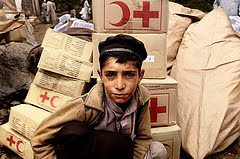

Reuters news service reported in late August 2010 that the United States has seen evidence that militants and affiliated charities in Pakistan have been deepening their involvement in flood relief in an effort to win popular support.  The U.S. State Department has issued warnings that insurgents may be targeting foreign aid workers responding to the crisis and Pakistan's inability to respond because it has been overwhelmed by the disaster.  This, even as the United States and it international allies rush to deliver additional aid.  One senior government official said that the militants were even dispensing money for victims of the flood.  Some of these charity groups have been linked to Lashkar-e-Taiba and its humanitarian arm, Jamaat-ud-Dawa, which were blacklisted by the United Nations and were blamed for the 2008 attack on Mumbai, the Indian commercial capital that resulted in the deaths of 166 people.


Jamaat-ud-Dawa (JuD), under the name of Falah-e-Insaniyat Foundation Pakistan, has set up approximately 29 relief camps in a number of flooded areas.  According to one report by the Times of India, Jud had set up camps in its own name until police started demanding extortion money.  JuD claims to have provided food to 50,000 flood survivors in all four provinces every day and was in the process of reaching out to 100,000 survivors.  Additionally, it claimed to be distributing packet of food, hygiene items, and other items to 8,000 families.


During a recent interview on the PBS Newshour television program, a reporter from GlobalPost stated that humanitarian efforts are in full swing in areas hit by the worst flooding.  However, most of these humanitarian efforts are not from international aid groups or the Pakistani government, but are from a hard-line Islamic charity, Falah-e-Insaniyat Foundation Pakistan, or JuD.  Medical teams were getting ready.  "Through their robust relief efforts, Falah has been able to buy loyalty."   According to this reporter,

Meanwhile, some three million flood victims have yet to receive aid, and international donor funds have nearly come to a standstill, according to the United Nations.  To address this crisis, Pakistan's prime minister announced that he will hold an international conference shortly.  It's something that might help the government itself fill the gap, instead of terrorist-linked charity groups.


There is one other problem that has surfaced recently that also might have some impact on the giving to charitable organizations in the donor nations for relief in Pakistan.  There was a recent, 5 September 2010, report in a magazine in the United States that reported:

Government agencies and Muslim relief organizations in Pakistan have been denying aid to thousands of Christians left homeless by the recent monsoon floods, say Christian sources in the overwhelming Muslim nation.
Aid agencies have been delivering food, clothing, building supplies and hygiene kits in an effort to prevent outbreaks of water-borne disease as the flood waters begin to recede.
But the Pakistan Christian Congress says the afflicted Punjab region is a "hotbed" of Islamic extremist organizations that view Christians as infidels, and local officials who fear the extremists have been barring Christians from tent camps set up for flood victims.

The Anglican Bishop in Peshawar, the president of Open Doors USA, and the president of Pakistan Christian Congress have addressed this problem and as the Lahore-based Daily Times said in a recent editorial:

Reports about systematic discrimination in aid distribution are utterly disgraceful.  If we want to progress as a nation, we need to close the doors on our prejudices.  For far too long we have let religious bigots call the shots.

The problem is that the only place where aid for many is available is the local mosque.  Under these circumstances, Christians, which comprise approximately two percent of Pakistan's 175 million people and are accused of blasphemy, are in extremely vulnerable situations.  While some are denied assistance, others are required to vacate the region or convert to Islam.


There is, it seems to me, one other factor that makes the comparison of funds raised for Pakistan relief or aid and that raised for relief and assistance for Haiti at the beginning of this year difficult.  Whereas, Haiti experienced a sudden disaster and devastation brought about by the earthquake, the flooding in Pakistan was a much more gradually occurring disaster.  Whereas one, because of the sudden event, attracted the media attention and presented the need in much more stark terms, the other simply occurred over time and the severity of the catastrophe grew on us as the media began to direct their attention on the flooding.


For reasons that might vary according to one's worldview, we can all agree that there is some level of moral obligation to provide assistance in the case of natural disasters, such as is being experienced in Pakistan.  What the basis, if any, of that moral obligation is, may not be clear now, but the question before us is how we are to give with the confidence that our giving will reach those in need.  While ICFO may not have all the answers, its members can provide some basis for understanding how charity monitoring may be serving as a "bridge of trust" between the donor and the charitable organization providing assistance in Pakistan, and indeed, to the victims and beneficiaries of that generosity.  Such is the subject of another post.

Wednesday, August 11, 2010

Accountability, Integrity, and Theories of Ethics


In my last several posts, I have raised several questions and thoughts to which I would like to return in this post
. The first is: The real question, it seems to me, is how is a charity, or some other NGO or CSO going to live and function with integrity in a society and in an era in which these challenges drive most of the thinking and acting in the world today? And recognizing that organizations are simply legal entities, how are we as leaders in the sector, including leaders of NGOs and CSOs, as well as of charity monitoring organizations, going to lead with integrity when there is so much that works against us. Does a focus on transparency and accountability, when those terms of devoid of any meaningful substance and understanding, undermine our consideration of what is really important in terms of ethical conduct in how an organization is governed, led, and managed? The second is related: When we speak of obligations to be transparent, accountable, and to act with integrity, are we really addressing the obligations of our public benefit organizations, or are we thinking that whatever obligations exist in such an organization, they exist derivatively?

There are three ideas that belong to the discipline of ethics. First, ethics always includes a theory of obligation. It is the basis on which a person or organization determines what it ought to do and what it ought not to do. In other words, theories of obligation concern the moral evaluation of actions as right or wrong, obligatory, permissible, or forbidden. Thus, the theory of obligation is what allows a person or organization to make moral judgments in a decisionmaking structure. Secondly, ethics always involves a theory of value. In other words, it answers the questions: What makes something good or valuable? What makes something bad? How does one place value or worth on something? What is the relationship between the values one holds and the decisions one makes? Third, ethics always deals with a theory of motivation. For example, what ought to be the self-conscious thoughts that go through a person’s mind as one does one’s duty, or as one applies one’s values in the moral decisonmaking.

In an earlier post, I raised the question as to whether "accountability" could be regarded as a moral virtue. Having said that, however, I don't mean to suggest that "accountability" should not be evaluated within the discipline of morality and ethics. It seems to me that if we are going to think of accountability in terms of morality or ethics, we should evaluate what makes up accountability on the basis of some theory of obligation, some theory of value, and some theory of motivation.

While there are different approaches, for example, to discerning the application of an appropriate theory of obligation, such an evaluation of accountability should at least account for a theory of obligation. Thus, it would make a difference if the theory of obligation, or duty theory, is one based on one of the categories of deontological theories on one hand, or on one of the consequentialist or utilitarian theories on the other.

Similarly, if one is to evaluate the reason for "accountability," it seems that there should be some consideration of the appropriate value theory that would require an organization to be accountable. Is accountability based on an intrinsic value, that is, on the basis that it is good in and of itself apart from any other consideration? Or rather, is it based on extrinsic or instrumental value, that is, on the basis that it has the capacity to produce something of value, such as, transparency, so that the decisionmaking process and operations of the organization can be clearly seen and understood by those outside the organization, and thereby increase the level of trust between donors and other stakeholders, and the charity itself?

What we often see missing in any discussion of integrity and accountability, whether in the case of governments, commercial or market organizations, or civil society organizations, is any discussion that addresses the theory of obligation. Rather, the discussion in the political and public discourse almost always centers around the use of the word, values, instead of the use of the words, ethics or morality. Thus, when we hear someone assert that the policy of a political candidate, a political party, or organization is based on certain values, does this have any meaningful ethical content?

Briefly, value theory, which is the philosophical discipline of axiology, addresses the various ways to understanding how, why, and to what degree humans should value things. Values are those things that are important and are valued by someone, who can be an individual or, collectively, an organization. In sociological terms, value theory is concerned with personal values that are held by a community or organization. Thus, different groups might hold to, or prioritize, different kinds of values that influence human behavior.

For example, I find listed on charity websites what are regarded as the core values of the charity, such as professionalism, caring, teamwork, loyalty, and the like. These are great values, but they don't say anything about an ethical duty to act, or refrain from acting in a certain way. They may be great goals, but they say nothing about whether the organization is acting with integrity, is transparent, is accountable, or whether or not there is any basis on which to judge whether what the organization has done is good or bad, is worthy of praise or is worth of opprobrium.

In the late 1980s and early 1990s, much of the political discourse in the United States addressed the subject of "family values," as something worthy to be advanced by the political campaigns or by the national or state governments. This platform essentially dealt with the role of the family in society, where the family was defined as a man and woman married to each other raising children within the family that were well-behaved, educated, and perhaps civically minded.

If values are the embodiment of what an organization values and stands for, they are also, or should also be, the basis for the behavior of all the members of that organization. If, however, the members of this organization do not share and have not internalized the values of the organization, there is a disconnect between the organizational values and the individual values. Assuming that an organization's integrity, transparency, and accountability are derivative, this disconnection between organizational values and individual values results in a dysfunctional organization in which there can be no real accountability, either internally or externally, and thus, no trust between the organization, as an organization, and its donors and stakeholders.

What is important to understand is that if ethics has to do with conduct and decisionmaking, the emphasis falls on the human will. It is the will, after all, that implements our choices. In fact, if we were to define “choice,” we might say that a choice is the mental discernment that predisposes us to a certain set of actions and that this predisposition will ultimately be implemented in an act of our will.

Once we have defined what belongs to the concept of conduct, and particularly, to the theory of obligation, it is important to decide what kind of methods are available in deciding what kind of ethic a person or organization should hold. There are a number of theories or methods available, especially in the philosophical literature.

The first is authoritarianism. In this case, all that one must decides is what authority one will accept. Thus, once an organization decides what authority, if any, it will accept, all it must do is check that authority to determine what that authority says that the organization can do, or cannot do, and then do it or refrain from doing it.


The problem is that there is a plethora of authorities that are available to us every day, all of which can assert claims on us in terms of our conduct. If the government is the authority, then all one must do is check the statutes, regulations, orders, administrative guidelines, government literature, and decisions of the courts and regulatory bodies, and do what these authorities say is required or refrain from doing that which is prohibited. Nothing else is required.

This reminded me of Aleksandr Solzhenitsyn's widely reported commencement address at Harvard University in June 1978, in which he described the legalistic life as follows:


Every conflict is solved according to the letter of the law and this is considered to be the ultimate solution. If one is right from a legal point of view, nothing more is required, nobody may mention that one could still not be entirely right, and urge self-restrain or renunciation of these rights, call for sacrifice and selfless risk: this would simply be absurd. Voluntary self-restraint is almost unheard of: everybody strives toward further expansion to the extreme limit of the legal limits . . . .

I have spent all my life under a Communist regime and I will tell you that a society without any objective legal scale is a terrible one indeed. But a society with no other scale is also less than worth of man . . . . Whenever the tissue of life is woven of legalistic relationships, this created an atmosphere of spiritual mediocrity that paralyzes man's noblest impulses.

Too often in our advanced Western societies, law defines the nature and limits of morality or ethics. As long as individuals follow what the law permits, or refrain from doing what the law prohibits, there are no other moral considerations or principles with which individuals should be concerned. There are no standards apart from the law to guide the individual or organization, nor are there standards against which conduct can be evaluated as being ethical, or morally justified.

Some of these same themes were woven into what Alexis de Tocqueville wrote over one hundred and fifty years ago in his Democracy in America, when he wrote:


The influence of legal habits extends beyond the precise limits I have pointed out. Scarcely any political question arises in the United States that is not resolved, sooner or later, into a judicial question. Hence all parties are obliged to borrow, in their daily controversies, the ideas, and even the language peculiar to judicial proceedings. As most public men are or have been legal practitioners, they introduce the customs and technicalities of their profession into the management of public affairs. The jury extends this habit to all classes. The language of the law thus becomes, in some measure, a vulgar tongue; the spirit of the law, which is produced in the schools and courts of justice, gradually penetrates beyond their walls into the bosom of society, where it descends to the lowest classes, so that at last the whole people contract the habits and tastes of the judicial magistrate.

As I wrote in a previous post, many regulatory schemes imposed by governments tend to work against the very purpose for the the existence and work of participants in the sector, or against the effectiveness of particular charities. Accordingly, if government is the ultimate authority to which we turn to define our theory of obligation, then moral precepts or ethical rules are nothing more or less than those dictated by government. Moral evaluation of what is right or wrong, obligatory or permissible, or forbidden is based on what the government proclaims and nothing else.

Moreover, the consequences of an organization's actions or inactions are legal. Therefore, administrative expenses increase as these organizations retain the services of accountants, lawyers, and direct mail fundraising or public relations consultants to avoid the legal risks flowing from the consequences of its actions or inactions..

However, more than that, accounting and accountability became the language used by experts to describe and evaluate the process of whether the money was treated in accordance with certain specific rules. In other words, the subject of accountability refers primarily as to whether the finances of an organization were disclosed as being in accordance with certain specific rules. Thus, if the only criteria to be disclosed with respect to whether an organization is accountable are the financial statements and tax returns or tax information, then a nonprofit organization may be accountable only with respect to those financial matters and whether or not they were reported in accordance with the specified standards and rules, and to nothing else.

Although perhaps not legally significant, a similar process would be applied with respect to other possible authorities. If the authority is a monitoring organization, such as one of the members of ICFO, for example, then all that is required is to examine the standards of ethical conduct issued by that ICFO member, and determine if the NPO in question has complied with those standards. Accountability here is often simply limited to certain disclosures of actions that are asserted to be in accordance with specified rules and procedures without regard to whether those actions are characterized by integrity.

The second method is a viewpoint that fits the scientific method very well. It is clear that the government or some regulatory monitoring body, such as a member of ICFO, may not have all the potential standards articulated that are relevant to the practice the charitable organization wants to follow. After all, the interpretation and application of standards is not simply a mechanical process in which certain clear rules or standards are applied to the situation in question, and the answer to the ethical question or dilemma quickly raises to the surface to provide definitive guidance for the direction that the charity should take. If, for example, a charity raises funds for a certain project, and the standard issued by the monitoring organizations specifies that no more than 25 percent of the funds raised may be used for fundraising expenses and overhead, it is a relatively simple process to determine whether the charity exceeded the ceiling for allocation of fundraising and overhead expenses.

Accordingly, in this scientific kind of system, one takes the ethical principle most applicable to the situation to see if it adequately explains the experience base upon which there has been moral decisionmaking in life. Where is the ethical principle weak and where is it strong? The problem is that this type of analysis is required for every ethical theory to see which best fits the moral phenomenon presented by the desired action or decision of the NPO. Once the analysis draws one's attention to a particular ethical theory, that is the ethical theory that one must choose. However, where the issue is one of how the solicitation for donations is worded, or whether the charity board exercised proper authority in approving a project, exact choice being made by the charity may not fit within clearly articulated standards.

I would like to suggest the nature of the moral dilemma today, and suggest how it relates to our topic of accountability. The only sanction that people seek today is individual approval for personal behavior, for doing one’s thing. Ethical imperatives have evaporated from one segment of life after another. Relative ethics is now the approved cultural ethical philosophy. And with it, we have experienced indifference to conscience, where a shocked conscience is now a minority phenomenon.

Too often, our major civil society organizations take their clues from this culture. How then are we to expect any level of accountability on the part of NPOs that really matters and that is based on transparency? Again, if accountability is regarded as merely disclosing the fact that certain acts or operations can be rationalized and justified on the basis that they conformed to specific rules and processes, such accountability would discourage thinking about integrity or the lack of integrity of the action or operations in question.

Secondly, there has been a loss of moral restraint. The loss of moral restraint has emptied life of meaning. It has destroyed a sense of destiny. It has resulted in a loss of conviction. It has produced a deep sense of futility, a sense of estrangement from society and community, and a penetrating national mood of cynicism in government and in government programs and in the direction of a nation.

Unfortunately, this sense of estrangement and cynicism may also be directed at NGOs, simply because they are recognized institutions in society. There may be some causal antecedents that help explain why we are where we are and what we in the third sector community interested in transparency and accountability should understand. Causality is not a simply notion. Too often there is more than one single cause. Nevertheless, there are a few that can be identified.

First, there has been a philosophical shift in the post-Renaissance world that emphasized two major ideas: the autonomy of human will, and the ideal of the ultimacy of process. If, indeed, the human will is autonomous and unconditioned, if it has no antecedents, if there are no standards by which it can be judged, if it is a law unto itself, then this obviously leads to moral relativism and to the kind of moral rebellion we have witnessed.

Secondly, in the case of the ultimacy of process, there is nothing fixed. Everything is in the midst of change and in process. There is a commitment to the fact that there are no fixed lodestars whereby we can evaluate anything that goes on. If everything is in process, then there can be no absolute obligations to act or refrain from acting in a certain way, no values by which we can determine whether something is good or bad, worthy or unworthy, and no absolute moral commands, because if something is absolute, then by definition it is unchanging. It is applicable to every culture, to all people, in all circumstances.

There is a third idea relevant to this moral revolution and that is the growth of scientific, psychological, and cultural anthropology. Humans are treated as nothing but machine-like animals to which one can apply certain technologies and thereby adapt human behavior and so that humans respond in certain ways. In cultural anthropology, we have seen how different value sets can be shown and that there are no fixed values or ethical absolutes.

The fourth idea comes from the instrumentalist educational philosophy espoused by John Dewey that divorced two things, values from facts that contributed strongly to an ethical relativity. According to Dewey, facts were objective and existed independent of the subject whereas values were subjective and chosen. Thus, if one were to affirm that he hates lying and deception, he would be expressing only his personal opinion, and according to this thinking, lying or deception cannot be ultimately wrong.

The fifth and final idea relates to the advancement of the scientific and technological revolution. The rate of rapid change in technology has caught our cultures breathless. There are no stable things anymore. The government knows you by a number on some identity card. The bank knows you by a coded number that computers read. We have become impersonal integers. Nobody asks whether one ought or ought not to do something; only whether it can or cannot be done.

What all this suggests is that the issue of accountability, even if we were able to define it as something good, is not an easy matter with which the government, the donor public, and the monitoring organizations must address. How does a government or a monitoring organizations establish Standards for Charity Accountability that are not merely arbitrarily imposed rules when there are no moral absolutes to back them up? How are NPOs to be accountable to the various stakeholders when there are no fixed standards based on some fundamental principles of integrity? This question become particularly difficult when one connects accountability to trust -- trust between the donor and the NPO. Maybe it also depends on whether we view the integrity and accountability of an NPO as derivative of the integrity and accountability of the individuals involved in its leadership.

The contemporary focus on institutional philanthropy has a secular cast that simply ignores any beliefs and attitudes that give rise to a culture of giving and to those ideas that are required to sustain it. Fewer than five percent of research projects on philanthropy dealt with religion, religious based charities, and religious motivations for giving. Yet, religious organizations are the largest recipients of giving, and religious motivation is one of the strongest impulses for giving. While not all religiously based charities operate with integrity and are as accountable as we might want, the religious impulses for giving and volunteering are real.

Whereas individual giving and support for charity stresses the efforts to help the poor and needy and work toward alleviating the present situation, supporters of philanthropy see their efforts directed toward society and the future, and in addressing long-term solutions. Philanthropy tends to be targeted to narrowly defined causes that address recognizable changes in social conditions. As such, these causes tend to require larger financial commitments, mainly from the wealthy and foundations. The recipients of philanthropy tend to be educational and arts institutions and organizations, medical research, and organizations that direct their activities toward promoting and improving the quality of human life. But, more about that in another post some day.

My observation over the years of working with monitoring organizations and serving on the boards of a number of NPOs bears out the fact that most donors give financial and in-kind donations, and volunteer time to those charities with objectives and programs matching the interests of the donors. Similarly, the vast majority of individual donors give to those organizations with which they have some ongoing relationship, either with the leadership of the organization, or with the charitable organization itself. While the vast majority of donors to these charities are loyal, those that drop off generally do so because their relationship with the organization or its leaders was not nurtured, or because of some change in their personal financial situation.

Giving always increases significantly when there are widely published reports of disasters, such as hurricanes, tsunamis, earthquakes, and fires, for example. The response in these cases tend to be more emotional than intellectual. Depending the level of publicity and the reputation of the charity soliciting funds for such major disasters, the existence of a monitoring organizations and the granting of a seal may have some influence on what charity is to receive the gift. The influence generally, however, is to merely confirm the legitimacy and accountability of the charity receiving the donation.

I am not sure that this is necessarily true in the case of how civil society organizations are funded by government grants, major foundations, and philanthropic grants.

What was interesting about a recent special report series in The Chronicle of Philanthropy on coping with the current economic situation was that almost all of the articles talked about the importance of developing trust between the charity, and by implication, between the public benefit sector and the larger general public. To do this, the sector must be transparent in its communications with the public and with donors.

But, I am convinced that it is more than simply being accountable in terms of the willingness to disclose financial information. It would seem that charity monitoring standards and independent, or self-regulation monitoring organizations, serve a useful purpose for engaging trust between donor and charitable organization, and might, therefore, have some role in promoting loyalty on the part of donors to their charities. More about this in a future post.

However, for now, let me just say that I have not found any strong data in the U.S. to support a correlation between independent monitoring of a public benefit organization such as would be done by one of the national members of ICFO, and the trust and loyalty between the donor and the charity. I think that the way in which accountability may serve the NPO community is that it is used to describe actions and activities which are in themselves moral, virtuous, and laudable. Nevertheless, I think too often we who are involved in the sector and who are part of the donor public, expect more from accountability than it can deliver.

Accountability will seldom legitimize the choices made by NPO leadership. Rather, it gives the leadership the opportunity to reflect on what it has done, to reflect on the leaders’ thoughts and motivations, words, deeds and omissions, and responses to internal and external forces, all essential features of human rationality.

At the core of its existence, the NPO and its leadership must be clear about its ethic, and act on that ethic. Otherwise, accountability will be nothing more than self-justification and rationalization for decisions made, too often decisions made on pragmatic reasons that have nothing to do with moral conduct.

While I believe that government does fill a useful purpose with respect to setting basic standards for the legitimacy of nonprofit organizations within the legal jurisdiction of that country, state, or province, I am not persuaded that governments are effective with respect to promoting accountability beyond a certain basic level of information required, such as for the disclosure of registration of nonprofit status and informational tax return forms, if required. Moreover, if accountability is to encompass transparency within specific charities so that the integrity or lack of integrity in all of its decisionmaking and operations is visible to those outside the organization, I am not persuaded that government is competent to address that nor that it is effective to ensure some level of trust based on that transparency and the integrity of the organization.

To illustrate my points here, on 28 May 2010, the U.S. Government Accountability Office (GAO) issued a report in response to a request from 31 Senators and Representatives from the U.S. Congress for information regarding federal funds provided for fiscal years 2002 through 2009 to selected organizations, involved in health-related activities, reproductive health care, routine examinations, screenings, contraception, abortion care, and testing and treatment for sexually transmitted infections. According to this GAO report, Planned Parenthood Federation of America and its affiliates had expended $657.1 million of federally granted funds during the period of 2002 through 2008. According to its annual reports and published reports, it received approximately $2.3 billion in federal grants and programs during the same period.

After weeks of investigation, the GAO was unable to account for $1.3 billion. Apparently the reason for this was that GAO could not account for the great majority of government money received by Planned Parenthood because that organization would not produce its internal audits for GAO to analyze. As a result, the GAO had to rely on reports filed by affiliates of Planned Parenthood Federation under the Single Audit Act, and those reports "grossly underreport the amount of money expended by Planned Parenthood." Planned Parenthood has not issued an annual report since annual report for 2007-2008.

It is difficult to understand the role of transparency and accountability, both with respect to the government's accounting for the funds provided Planned Parenthood through grants and programs, and with respect to Planned Parenthood's the apparent inability to meet some standards of accountability for all funds it received from the government, and its failure to produce its internal audits for GAO.

Charity Navigator has given Planned Parenthood Federation of America a four star rating, based in part of its ratios of fundraising expenses and administrative expenses to program expenses. It seems that if a substantial portion of its revenues are derived from government grants and programs without the usual expenses associated with fundraising, the ratios would be better than in the case of a charity that must raise funds from individual donors. Without drawing any conclusions concerning the transparency, accountability, and integrity through the application of theories of obligation, value theory, or motivations on the part of the leadership of Planned Parenthood Federation of America, my only concern here relates to the challenge to both government and sector have in promoting transparency and accountability when there are no fixed standards against which we can evaluate the actions of a nonprofit organization as right or wrong, permissible or discouraged, obligatory or forbidden, good or bad, valuable or worthless, worthy of praise or worthy of scorn.


TAP

Thursday, July 22, 2010

Why Do We Need NPO Accountability? Or, Do We?*


We are glad that we can say with utter honesty that in all of our dealings we have been pure and sincere, quietly depending upon the Lord for His help, and not on our own skills.

My letters have been straight forward and sincere; nothing is written between the lines!

We use no hocus-pocus, no clever trick, no dishonest manipulation of the Word of God.

And even though you don’t know me well (and I hope someday you will), I want you to accept me and be proud of me, as you already are to some extent.

We want to avoid any criticism of the way we administer this liberal gift. For we are taking pains to do what is right, not only in the eyes of the Lord, but also in the eyes of men.


2 Corinthians 1:12-14, 8:20


My last series of posts addressed challenges to the whole idea of transparency and accountability. In this post, I would like to take on the basic question of accountability, and what it is all about, particularly as we look at the nonprofit sector. As you will note, there are some overlaps between the problem of analyzing what accountability looks like and what some of the challenges are to transparency and accountability.

In a recent release from the Harvard Business School, Working Knowledge online forum in the Executive Education Program, the Executive Summary of faculty research by Dr. Alnoor Ebrahim and his paper,
The Many Faces of Nonprofit Accountability, stated:


Nonprofit leaders face multiple, and sometimes competing accountability demands from numerous actors (upward, downward, internal), for varying purposes (financial, governance, performance, mission), and requiring differing levels of organizational responses (compliance and strategic). Yet is it feasible, or even desirable, for nonprofit organizations to be accountable to everyone for everything?
The Executive Summary goes on to point out that few nonprofits have paid serious attention to how they might be more accountable to the communities they seek to serve. Moreover, as Professor Ebrahim noted in his paper's abstract, "nonprofit leaders tend to pay attention to accountability once a problem of trust arises -- a scandal in the sector or in their own organization, questions from citizens or donors who want to know if their money is being well spent, or pressure from regulators to demonstrate that they are serving a public purpose and thus merit tax-exempt status."

In his
INTRODUCTION, Professor Ebrahim affirms that "at its core, accountability is about trust." As he points out, many definitions of accountability define it in terms of "a process of holding actors responsible for actions." What the various definitions of accountability seem to share is the understanding that accountability centers on the relationship of various actors, with some giving accounts of their behavior and others receiving and judging those accounts. Furthermore, most of these discussions pose two further questions: Accountability to whom? And accountability for what? It is this second question that interests me in this post.

In Plato’s
The Republic, the myth of Gyges sets out the question: Why be moral? Gyges was given the opportunity to live life invisibly, able to do anything he wanted to do without anyone discovering what he had done. Given the chance to live like this, Plato raises the issue: Would a person want to be moral? After further dialogue, Plato concluded that being moral was inherently valuable, apart from any benefits one might experience from being moral or harm one might avoid from being moral.

Being moral is normally associated with doing well in life as a person. It is the principal reason that is central to most concepts of human fulfillment. Doing well in life and being a good person seem to fit together for most people. The same is true in the case of society or even organizational life. Most people would not want to be members of a society in which morality was unimportant and in which conceptions of right and wrong carried little or no weight. This is true even if they would define morality relativistically and maybe even a little narcissistically.

Similarly, most people would not want to associate with a charitable organization, either by work, volunteer support, or funding, if morality carried no weight, if there were no concerns for right and wrong, and if there was no concern for important moral virtues, such as fairness, justice, truthfulness, and compassion, as Aristotle would define them.

If accountability simply involves a process of being held responsible for one's acts, then what is the point if there is no moral core against which those acts can be evaluated. It is, therefore, appropriate, that the idea of NPO accountability be associated somehow with the context of morality or ethics if trust has anything to do with the relationship between actors. After all, “accountability” has become the term of modern political correctness in our society to describe a process that has little to do with the choices that are being made by governments, organizations, including NPOs, or individuals. It has displaced the virtues identified above as important to our governments and civil society institutions.

What good is accountability if there is nothing significant for which an organization must account? Why should anyone care, donor, general public, government, volunteers, direct hires, or anyone else, about whether an NPO claims to be accountable if there is no sense that the work of that NPO reflects the choices made by that NPO that promote virtues, such as, fairness, justice, truthfulness, compassion, or some worthwhile public benefit goals if the communications cannot be trusted as truthful and are self-serving or self-justifying?

British journalist, Steve Turner, wrote some years ago in a satirical poem describing the nature and consequences of post-modernity:


We believe that man is essentially good.
It’s only his behavior that lets him down.
That is the fault of society.
Society is the fault of conditions.
Conditions are the fault of society.

We believe that each man must find the truth that is right for him.
Reality will adapt accordingly.
The universe will readjust.
History will alter.
We believe that there is no absolute truth
Except the truth that there is no absolute truth.

I think too often that this is what captures the nature of our culture, and this is why the use of the terms, transparency and accountability seem to mean so little.

As I wrote recently (http://www.RVanBroekhoven.blogspot.com/, Alexis de Tocqueville and Civil Society), a key feature of the civil society movement is its role in influencing and transforming culture. In some cases, that role is clear and unambiguous, as in the case of the advocacy non-government organizations and not-for-profit organizations. In other cases, such as charity, humanitarian, and mercy NPOs, the care for the poor, the sick, the needy, also provides a transformative role in society, not only by meeting real needs of people, but of modeling the moral dimensions of fairness, justice, truthfulness, and compassion for example. However, how an NPO raises funds, is governed, and truthfully discloses its choices to the government, to the public generally, to donors and potential donors, and to monitoring organizations, could demonstrate a transformative moral role model in transparency of its decisionmaking processes.

I noted previously in this blog that a number of studies in recent years regarding the third sector in the United States, especially those reporting funds raised, volunteers participating in charitable activities, and the economic power of the sector, generally had not included data and analysis of the role and work of religious charities.
See for example, my papers: Engaging Donors' Trust, www.icfo.de, "ICFO Publications," and Engaging Public Trust and Donor Loyalty, www.icfo.de/agm-2009/van-Broekhoven.pdf.

What I noted in these papers was a criticism voiced in the United States regarding the understatement of the presence and influence of religious beliefs, institutions, and charities in American life. Fifteen years ago, Yale University law professor Stephen Carter wrote his book,
The Culture of Disbelief: How American Law and Politics Trivialize Religious Devotion. This book was, and is important for a number of reasons.

One is that it included the consequences to a society that excludes religion and religious belief and dialogue from the public square. Thus, too often religion and religious beliefs have been viewed as arbitrary and unimportant, fads and hobbies, rather than fundamentals upon which the devout build their lives and a society builds communities in which all can seek and contribute to the public good and happiness, to use a quaint ancient philosophical expression.

Secondly, as Professor Carter pointed out, when Alexis de Tocqueville visited the United States in the early 19th Century and wrote his classic book,
Democracy in America, he noted that the first thing that struck him was that religions provided Americans with the strong moral character without which a democracy cannot function, but that it also as importantly, filled in the vast space between the people and their government, a space the government might otherwise fill.

Most statistics regarding giving in the United States, and in other countries I have examined, tend to be less than somewhat precise. According to some studies, giving to charity in 2007 exceeded $314 billion. Giving dropped slightly in 2008 to $308 billion with the world-wide economic downturn or slump. The major exception to this reduction in giving was giving to religious charities and institutions. The statistics for 2007 and 2008 did not include more than $100 billion given to religious organizations, such as churches, foreign mission organizations, church operated food kitchen and homeless shelters, camps, and large religious institutions, such as the Salvation Army, the Roman Catholic Church, and the Church of Jesus Christ of the Latter Day Saints (Mormon Church).

More than 89 percent of all households in America gave to Charity, and more than 55 percent of all American adults volunteered services to charity, thus representing the equivalent of more than 9 million full time workers at a value of $239 billion. Aside from the sheer numbers, what I found interesting about one study was that it found that religious motivation was one of the strongest impulses for giving and volunteering service, and that religious organizations were the largest recipients for giving and providing charitable services. Indeed, as several studies reported, individuals who attended religious services frequently tended to give more to charity, whether or not the recipient charity as a religious organization or secular organization, and tended to be more active in volunteering services to charities. More about this in a future post.

But for now, I simply note that the verses quoted at the beginning of this post have been the guiding foundational principles for the founding and continued presence and influence of the Evangelical Council for Financial Accountability in charity monitoring in the United States.

The Evangelical Council for Financial Accountability (ECFA) in the United States was established in 1979 as the first accrediting organization devoted to monitoring the financial accountability of protestant evangelical charitable organizations in the United States. It first established Standards of Responsible Stewardship, and then monitored charities against those Standards granting a seal of approval to those organizations meeting all the requirements of the Standards.

The Standards were based on fundamental principles defining the boundaries against which NPOs could examine themselves to see whether or not they were operating with integrity. The assumption then, based on the Biblical passages quoted above, was that accountability to God is vital, but also in recognition that people form impressions of organizations by looking at the outward appearances. The Standards were developed from the founders’ understanding of Biblical teaching and were considered fundamental to how a religious organization was to operate with integrity.

For reasons beyond the scope of this paper, ECFA’s mission of establishing Standards of Responsible Stewardship and monitoring compliance against those standards was limited to protestant, evangelical nonprofit organizations. There had been a number of consumer protection laws and concerns that led to the American Congressional attention to fundraising within the nonprofit community, including unions and religious charities. It is sufficient to say that because of U.S. Constitutional considerations of separation of Church and State, the establishment of ECFA was thought to be an appropriate response to U.S. Congressional efforts to regulate the entire charitable sector, which would have included churches and religious charities and institutions.

But, recalling Tocqueville's observations, there is also a bigger issue. Namely, how Americans recognize the distinction between the government, individuals, and various social groups. At stake is not simply recognizing the Constitutional matter of the First Amendment's so-called separation of Church and State. Rather, at stake is the whole Constitutional framework for explaining social life in which the only active agents seem to be the individual and government. As one commentator wrote, "except for corporations, which the [U.S. Supreme] Court has recognized as persons and endowed with rights, groups and associations which stand between individuals and the State all too often meet with judicial incomprehension."

Nevertheless, as quoted above from the Bible, there was a religious dimension to both the motivation for establishing a system of accountability in the religious community and how it is to be administered as long as it is understood that accountability is about giving an account to human beings about the choices that were being made by the organization. It is interesting that even the Apostle Paul thought that it was important to disclose his activities with respect to his fundraising efforts and the management of the funds he received for his work.

Although we may be from different faith communities and cultures, or subscribe to no faith at all, the basic principles of integrity, transparency, and truthful disclosures of the decisionmaking activities and finances seem to be relevant to what we are all about when we talk about NPO accountability.

The initial thrust of ECFA and of many monitoring organizations was directed toward ethics in fundraising, proper accounting of funds, and appropriate disclosure of financial statements and conditions, all of which address financial matters of the NPOs being monitored. Indeed, the origin of use of the word, “accountability,” is in finance where accounting was telling the story of what had been done with the money entrusted to the government, the NPO, or to individuals.

However, as ECFA discovered, there is more to an organization’s integrity and accountability than merely meeting certain standards relating to financial statements and disclosures.

During the last three decades in the United States, and I suspect elsewhere, NPOs have been rocked with a series of scandals involving inappropriate expenditures, excessive executive compensation, self-dealing, corruption at various levels of NPO activities, and conflicts of interest. Is it possible for there to be corruption and moral failings without their exposure in well-prepared and audited financial statements, and that such failings may only have limited immediate financial impact on financial statement? Could it be that such corruption and moral failure would go to the very nature and viability of the NPO in performing its public purpose?

Immoral or unethical behavior in all areas of a nonprofit organization’s operations undermines public confidence in the work of the nonprofit sector and potentially threatens the success of its fundraising efforts. As a result of its findings and determinations in compliance reviews, ECFA revised its standards to include consideration of whether or not an organization’s conduct in all of its affairs was ethical and consistent with its affirmation of its Biblical beliefs.

Unique to ECFA in the United States is this theological basis for the beliefs and practices of those nonprofit organizations that seek to be monitored by ECFA. This theological framework and orthopraxis is the glue that holds all of ECFA accredited nonprofits together in a cohesive community of charities engaged in some form of Christian ministry. This is true whether it is humanitarian relief and development, disaster relief, meeting the needs of the sick, the homeless, and the poor, Bible translation, or planting churches among unreached people groups around the world, and primarily in the tw0-thirds world. The Canadian monitoring member of ICFO, The Canadian Council of Christian Charities (CCCC) has a similar theological framework and program.

It is also important to note that only those nonprofit organizations that join in this common basis of belief and seek accreditation are monitored. This leaves a large segment of the religiously based nonprofit sector without any required accountability to the donor public through compliance with simply stated Standards of Responsible Stewardship.

In the case of both religious and nonreligious NPOs, some of which are monitored by the BBB Wise Giving Alliance, and other state-based monitoring organizations, only a very small percentage of NPOs are monitored for governance, compliance with some Standards, and disclosure of financial information leaving the vast majority of NPOs without any requirements of accountability other than those minimal requirements prescribed by government tax laws. This does not mean that NPOs that have not sought accreditation through an external monitoring system are operating outside the boundaries of integrity and “accountability” to someone.

The idea of “accountability,” while not a moral virtue in and of itself, suggests an underlying ethical or moral concern. If accountability means that an individual or organization or even a government is liable or answerable to another, or is subject to the obligation to report, explain, or justify something, then there must be an underlying obligation to act or fail to act in a given area of one’s responsibility. Thus, if a nonprofit organization raises funds for a certain project or for its public benefit purpose, there are certain ethical standards that govern the way funds may be raised and that would proscribe certain means by which they may be raised. A disclosure requirement regarding the raising, management, and use or distribution of funds is a principal means of achieving some level of accountability.

Moreover, the concept of accountability addresses the subject of accountability and to whom that accountability is owed and this may be both its strength and its weakness. In other words: Accountability to whom? and "Accountability for what? Originally, accounting and accountability were related to finance, but involved telling the story of what had been done with the money entrusted to an individual or organization. The auditor certified that the accounts were true and fair.

But through the application of complex and somewhat arbitrary rules to evaluate the activities of individuals in an organization, accounting and accountability then no longer told an understandable story about what happened to the money and how decisions were made. Rather, accounting and accountability became the language used by experts to describe and evaluate the process of whether the money was treated in accordance with certain specific rules. In other words, the subject of accountability refers primarily as to whether the finances of an organization were disclosed as being in accordance with certain specific rules. Thus, if the only criteria to be disclosed with respect to whether an organization is accountable are the financial statements and tax returns or tax information, then a nonprofit organization may be accountable only with respect to those financial matters and whether or not they were reported in accordance with the specified standards and rules, and to nothing else. It seems to me that this is the essence of rating systems employed by some charity monitoring organizations.

If the government prescribes the rules of accounting, governance, fundraising, or some operations practice, then the individual or organization may be required to report, explain, or justify its actions to the government and to the public if the government prescribes laws that require that kind of public disclosure or availability of information. If the stakeholders, such as donors, beneficiaries, or public are the objects to whom accountability is owed, then the charity has the obligation to report, explain, or justify its actions to the stakeholders. If there is a monitoring organization that has issued standards of ethical practices, or as some would say, standards of responsible stewardship, then the accountability of the charity also would flow to the monitoring organization, not simply because it is a monitoring organization, but because it may represent the interests of the stakeholders.

It would seem, therefore, that the concept of “accountability” cannot exist alone and without some external reference or moral principle. If there is to be true accountability, then the individual or organization must be “transparent.” So, for example, when we think of something being transparent, we think of something having a property or quality so that rays of light can be transmitted through its substance and so the bodies beyond or behind it can be distinctly seen. When we think of this in terms of how a charity is administered and led, we think of that charity or individual as being open, frank, honest, and candid, so that what is behind the scene, whether agenda, decisionmaking, financial integrity, responsible governance, can be recognized and detected by those outside the immediate organization. In other words, that which is transparent allows objects to be clearly seen without distortion or being obscure.

But even then, transparency is not a virtue as such. What transparency does, however, is to point to one of the principle weaknesses of accountability. If accountability is about giving an account of one’s actions or failure to act to human beings, there is the possibility of spin or advocacy that can give a false impression of the true facts. Or, the human beings to whom one gives an account may not know all the relevant facts, or be defective in his or her judgments.

It seems appropriate to think also of accountability in connection with the idea of “stewardship.” I remember during the 50th Anniversary Annual General Meeting of ICFO in Berlin in 2008 that a number of the speakers referred to the term, "stewardship," in their presentations on accountability in the NPO sector and my thinking at the time that this analysis of the reason for and nature of accountability was so interesting.

The use of the term, “stewardship,” in third sector literature is interesting for several reasons. The Greek word translated as “stewardship” means the management of a household. It simply refers to the administration of duties or goods in one’s care. So, the requirement for stewards is faithfulness, and specifically, faithfulness in the administration of trust according to directions. While the modern understanding and emphasis on stewardship tends to direct our attention to possessions, which is certainly a significant factor, it can obscure the fact that stewardship also involves the use of one’s life as well as money.

Although the use of the word, “stewardship” has been primarily understood in religious literature and context, it is interesting that it is used so frequently in the literature regarding the nonprofit sector. First, it suggests that the funds, property, and assets we possess as individuals, ultimately belong to someone else and, therefore, we are responsible for the management of those funds consistent with fiduciary responsibilities. Secondly, it suggests that nonprofit organizations and institutions do not actually own the funds, property, or assets that come to their possession. Rather, they are held in trust, to be managed and used for the purposes for which the organization was established and consistent with the intent of the donors. Third, the concept of stewardship of necessity involves accountability and reporting to the master as to how that trust has been satisfied in the operation and management of that which was entrusted to the steward. Thus, the leadership of the NPO has an obligation to be accountable with respect to the management and operation of the NPO to the governments that give it authority to exist as an NPO with some specified tax status, to the public that donated goods, services, and funds to sustain it in its public benefit purpose, and to those organizations which have authority to oversee or monitor public benefit organizations.

Yet, even here the term “accountability” is ambiguous.

In the initial and original Standards established by ECFA at the time of its founding, the key Standard was one that required financial disclosure, where “every member shall provide a copy of the current financial statements upon written request and provide other disclosures as the law may require.” This is the current statement of that Standard and does not differ substantively from the original Standard issued in 1979.

Similarly, the BBB Wise Giving Alliance contains in its Standards of Charity Accountability, the requirement to “make available to all, on request, complete annual financial statements prepared in accordance with generally accepted accounting principles,” and then describes what must be contained in the financial statements. Its Standards also require certain information to be disclosed on the charities’ websites. It seems to me that without the principle of stewardship, there can be no real basis of accountability, either to government authorities or to the public and donors.

However, once again we see in the BBB Wise Giving Alliance Standard the idea that accountability addresses the accounting of financial information, gathered and reported in accordance with certain specific rules.

In the case of ECFA, the Standard requiring disclosure speaks in terms of financial disclosure but without reference to their preparation in accordance with certain accounting rules. What is also interesting about the ECFA Standard relating to disclosure is that it also requires "other disclosures as the law may require." What those other disclosures are, and what the law requires is not specified. But, the commentary for that Standard addresses the more important issue of integrity in all operations and activities of the organization, and the importance of transparency in the context of stewardship. Thus, the commentary states: "They [Christian ministries, Christian NPOs] must also conduct themselves and give an account to their respective constituencies in accordance with biblically informed practices of integrity and accountability." According to the commentary on this Standard, public disclosure of financial information protects the NPO from the danger of claiming ownership of these assets held in trust and from the temptation to regard the assets and acquisition thereof as our lasting companion and goal.

As Professor Ebrahim of Harvard University wrote, "at its core, accountability is about trust." However, if “accountability” is not really a virtue or a moral principle, then what does it have to do with NPO trust? If “accountability,” like accounting is a process that might lead us to truth, even though there is a risk of deception, spin, advocacy, fraud, or misunderstanding for example, how is it believed to serve the NPO sector building bridges of trust between the sector and the public. It seems to me that more is involved than simply accountability. There must be an underlying practice of integrity and morality in the choices made by the leadership of the NPO.

Assuming, therefore, that there is a requirement for ethical practices in the leadership of a nonprofit organization and that it is inherent in the concept of accountability, then our attention is of necessity directed to the subject of ethics. Indeed, how can there be any accountability and any real trust between donors (and the general public) and the nonprofit organization, and indeed the nonprofit sector without some ethical basis on which that trust must be based? This, then, brings up the subject of ethics and the role of ethics in society, particularly as it pertains to the relationship of the third sector to society.

This raises another interesting question. Although the United States Supreme Court has recognized the corporation as a "person" for purposes of Constitutional application, as I mentioned above, the legal understanding regarding associations, religious organizations, including churches, and organizations within the nonprofit sector is less clear. Groups, including families, the church, associations, foundations, and nonprofit organizations are virtually invisible in American legal and political discussions, except when they are recognized, mainly negatively, as interest groups. So the social importance and significance which these groups have on our social life and social well-being is not something that is readily recognized and understood.

While the State may have no trouble recognizing that certain rights and obligations belong to individuals, it has a far more difficult time recognizing that these groups, such as, families, the church, associations, foundations, and nonprofit organizations have any rights and obligations, other than those which are only derivative from the individual.

Therefore, when we speak of obligations to be transparent, accountable, and to act with integrity, are we really addressing the obligations of our public benefit organizations, or are we thinking that whatever obligations exist, they exist derivatively. I hope to explore the implications of this idea in my next post.

* Some of the substance of this post was presented in Taipei, Taiwan in December 2009 at the International Conference on NPO Accountability 2009 -- NPO Trust, sponsored by the Taiwan NPO Self-Regulation Alliance.